

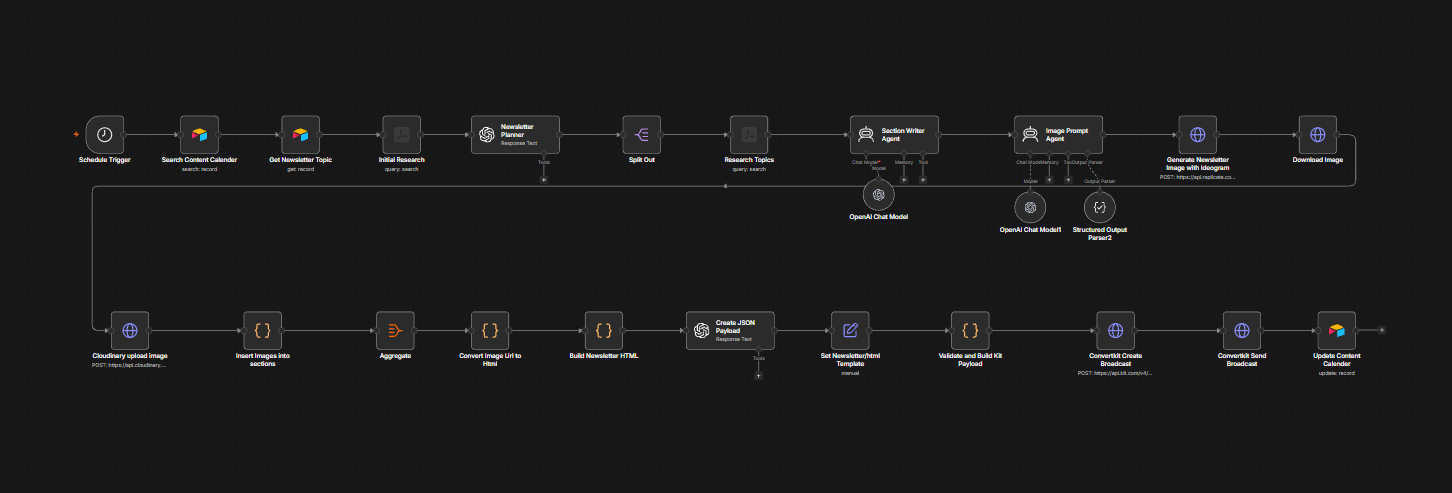
An AI-powered newsletter production system that turns a planned content topic into a researched, structured, visually supported, branded email newsletter, then validates, delivers, and tracks the completed publication through one repeatable automation pipeline.
The Business Problem
Producing a newsletter consistently involves considerably more than generating email copy. Each issue needs a planned topic, research, editorial structure, section development, supporting visuals, branded formatting, delivery, and a reliable record of what was produced.
When those stages are handled manually, the process becomes repetitive and difficult to maintain consistently. Research can become disconnected from the final content, visual assets have to be created separately, the email needs to be assembled and validated, and the original content plan still needs to be updated after publication.
I built this system to connect those stages into one repeatable production pipeline. The business controls what should be published through the content calendar, while the automation handles the research, editorial production, visual creation, email assembly, delivery, and operational tracking that follows.
What I Built
The system uses an Airtable content calendar as the operational source of truth. A scheduled n8n workflow retrieves the newsletter topic and moves it through two stages of research, editorial planning, section-level writing, visual generation, HTML assembly, validation, ConvertKit delivery, and Airtable status tracking.
Rather than asking one AI step to research, structure, write, design, and deliver the entire newsletter in a single pass, the workflow separates those responsibilities. This creates clearer boundaries between research, editorial decision-making, content generation, visual communication, and deterministic production work.
Research & Editorial Planning
Broad topic research informs a dedicated planning stage that determines the newsletter structure and five distinct section topics.
Section-Level Production
Each planned section receives focused research and is written as an independent HTML section with its own supporting sources.
AI-Directed Visuals
A separate visual stage determines how each section should be communicated before the selected image-generation model produces the supporting assets.
Assembly, Delivery & Tracking
The completed sections and visuals are assembled into the branded email, validated, delivered through ConvertKit, and recorded back in Airtable.
How the System Works
The architecture deliberately separates broad research from focused section research. The initial research establishes context for the newsletter planner, the planner creates exactly five editorial topics, and those topics are then researched individually before the section writers produce the final content.
Content Calendar
n8n Trigger
Research
Planning
Topics
Research
Writing
Creation
Assembly
ConvertKit
Update
This creates a deliberate progression from broad context to focused production: the business controls the content plan, AI handles research interpretation and editorial decisions, and the automation layer makes the resulting production process repeatable.
From Content Plan to Delivered Newsletter
The production journey is deliberately structured so that each stage receives the information produced by the stage before it. That keeps the final newsletter connected to the original content plan instead of treating the AI outputs as isolated generations.
The newsletter topic originates in Airtable, alongside information such as the audience tag, publication date, and production status. A scheduled n8n execution retrieves the relevant record and starts the production pipeline.
Tavily performs broad research around the newsletter topic. This establishes the source material and context that the editorial planner uses when deciding what the newsletter should cover.
The Newsletter Planner turns the researched topic into a defined editorial structure containing one newsletter title and exactly five distinct section topics. The planner decides what each section should accomplish rather than writing the entire newsletter itself.
The five planned topics are split into individual research jobs. A second Tavily stage gathers focused information for each section, and the Section Writer Agent turns that research into one standalone HTML section with its own heading, useful content, and relevant sources.
Each completed section is passed to a separate Image Prompt Agent that determines an appropriate visual approach. The selected visual work is generated using Ideogram V4 Balanced through Replicate, then uploaded to Cloudinary for use inside the newsletter.
The generated sections and corresponding hosted visuals are combined programmatically into the branded newsletter structure. The completed HTML is normalized and validated before the delivery payload is prepared for ConvertKit.
The completed newsletter is passed to ConvertKit for broadcast delivery. In the demonstrated run, the finished newsletter was successfully delivered to the configured three-subscriber test audience.
After delivery, the original Airtable content-calendar record is updated with the publication information and its status is changed to Done, closing the loop between planning and completed production.
The Generated Newsletter
The completed output is a fully assembled newsletter rather than a collection of raw AI generations. The demonstrated issue contains the editorial content, five structured sections, supporting infographic-style visuals, M-Automations branding, responsive email formatting, and the final delivery payload.
The completed newsletter is shown directly above. The demonstration loops automatically and can also be viewed with playback controls.
Key Capabilities
Airtable provides the planned topic, audience information, publication details, and production status that drive the workflow.
Broad topic research is followed by focused research for each planned newsletter section.
A dedicated planner creates five distinct section topics before the writing stage begins.
Each section is researched and generated independently with its own structure and relevant sources.
Visual direction is separated from writing so supporting graphics communicate the information rather than simply decorate the email.
Generated visuals are matched to their corresponding newsletter sections during assembly.
The individual sections and visuals are assembled into a consistent branded email structure before delivery.
ConvertKit handles delivery while Airtable records the completed publication state.
One planned topic becomes a complete newsletter publication.
In the demonstrated run, an Airtable content-calendar topic moved through scheduled execution, initial research, editorial planning, five section topics, focused research, section-level writing, visual generation, image hosting, HTML assembly, validation, and ConvertKit delivery. The completed newsletter was delivered to the three-subscriber test audience, and the original Airtable record was updated with the publication information and Done status.
Tech Stack
AI becomes more useful when it is given a defined responsibility inside a deterministic production system.
This workflow deliberately avoids treating AI as one large black-box content generator. The business controls the content plan, initial research establishes context, the planner defines the editorial structure, focused research supports each section, the section writer produces the content, the visual agent determines how the information should be communicated visually, and programmatic logic handles mapping, assembly, validation, delivery, and tracking. The result is a more controlled production pipeline where each stage has a clear responsibility.